
Introduction
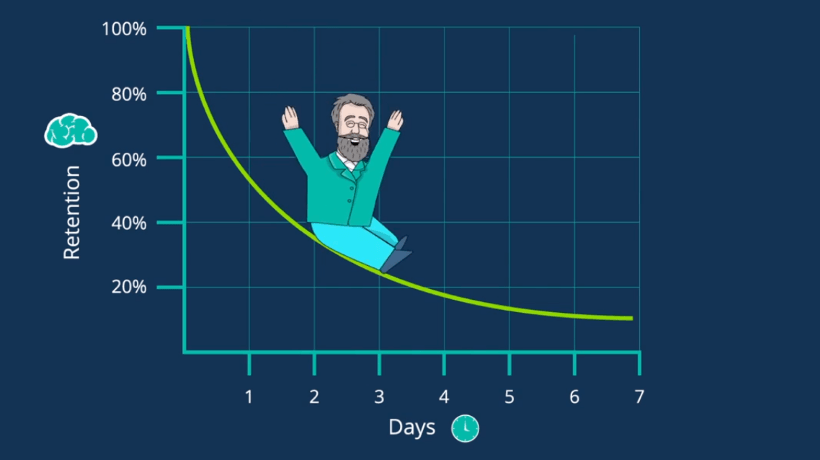
If you work in Learning and Development (L&D) for very long, you’ll hear about the Forgetting Curve. Originally published by Hermann Ebbinghaus in 1885, the Forgetting Curve hypothesizes that as soon as we learn something, we start forgetting it. The rate of forgetting is quick at first and slows down over time. But is the theory grounded in valid research?
A participant raised this concern after I discussed the Forgetting Curve in a recent presentation. He sent me a long message cautioning me against using Ebbinghaus. I may be somewhat of an “old dog,” but I try to ensure that my designs are grounded in evidence-based learning theory. So, let’s dig into what the research says about The Forgetting Curve.
Ebbinghaus's Methodology
Let’s start by looking at how Ebbinghaus conducted his research that led to his discovery of the Forgetting Curve. Over two periods, each lasting more than a year, Ebbinghaus performed memorization tests in which he attempted to memorize a series of syllables and documented his results. He later repeated the tests before publishing his results.
As a psychologist, Ebbinghaus was meticulous and precise in his methodology, as described in his writings. He documented his rules for the memorization process, which included reading a series of syllables completely from beginning to end, using a metronome or ticking watch to ensure a constant rate of speech, and predetermining which syllables to stress when speaking.
In the 139 years since his work was published, many have criticized Ebbinghaus’s methodology. The biggest problem is that he used a sample size of one—himself. He recognized this limitation, writing, “It goes without saying that since the results reported were obtained from only one person they have meaning only as related to him. The question arises whether . . . by repetition of the tests at another time, they could be expected to show approximately the same amount and grouping.” (More on this in a bit.)
Another common objection is that he memorized a series of nonsense syllables rather than testing recall of meaningful information. However, Ebbinghaus saw this as a strength of his research rather than a weakness, because it reduced the variables that could affect how memorable the material was (or not)—such as prior knowledge, humor, or imagery called to mind by descriptive terms.
He later repeated his study, memorizing stanzas of Lord Byron’s poem, Don Juan, finding that learning meaningful information required one-tenth the effort of memorizing nonsense syllables. This doesn’t negate his prior results but emphasizes the importance of context in learning.
The Forgetting Curve
Contrary to what many believe (and have written), Ebbinghaus didn’t plot his data when he published his findings. The line charts we associate with the Forgetting Curve came later.
Some sources illustrate the Forgetting Curve as a literal curve similar to a waterpark slide, but the chart below from Murre and Dros plots Ebbinghaus’s results more accurately.

On this chart, 0.01 represents 20 minutes, 0.1 represents 1 hour, and 1 represents 1 day. Savings refer to the “relative amount of time saved on the second learning trial as a result of having had the first.” His findings show a sharp decline in retention after 20 minutes that levels out after 24 hours.
We often summarize the Forgetting Curve with generalized data like, “we forget about half of what we learn after an hour.” The danger comes when we assume that (a) this is always true for everyone and (b) we accept it as an immutable fact that we can’t change.
When I discuss the Forgetting Curve, my whole point is that learners will forget what we teach unless we’re intentional about helping them remember. That’s the takeaway. So, in my opinion, those who object to any reference to Ebbinghaus’s Forgetting Curve are missing the point.
Ebbinghaus's Influence on Learning Theory
Regardless of any objections to his methodology or how people have used his results, we cannot deny Ebbinghaus’s influence on what educational psychologists and learning professionals now believe to be true about learning and memory.
Ebbinghaus studied the effects of repetition and time on retention. While, to my knowledge, he didn’t coin the phrase, “spaced repetition over time,” he did theorize that spaced repetition over time improves retention, as he observed in his results.
With any considerable number of repetitions a suitable distribution of them over a space of time is decidedly more advantageous than the massing of them at a single time.
Hermann Ebbinghaus
About the limitations of his own memory, Ebbinghaus wrote, “What number of syllables can be correctly recited after only one reading? For me the number is usually seven.”
Compare that to George A. Miller’s findings 71 years later, which he presented as “The Magical Number Seven, Plus or Minus Two:”
There is a clear and definite limit to the accuracy with which we can identify absolutely the magnitude of a unidimensional stimulus variable. . . . I maintain that for unidimensional judgments this span is usually somewhere in the neighborhood of seven.
George A. Miller
It is from Miller’s work that we get the concept of chunking information to make it more memorable, and this feeds into John Sweller’s Cognitive Load Theory, put forth in 1988, which says that working memory can process five to nine chunks of information at a time (seven, plus or minus two).
Ebbinghaus also discovered that we are more likely to remember information that comes at the beginning or at the end—something he called the “serial-position effect.” Now, we know this as the primacy effect and recency effect, thanks to researchers who built upon Ebbinghaus’s findings.
Replication of the Forgetting Curve
Over the years, researchers have repeated Ebbinghaus’s study to determine whether the Forgetting Curve can be replicated. And the resounding answer is yes. The chart below plots Ebbinghaus’s original results alongside some of the subsequent studies.

Other memory research, which tested recall of meaningful information rather than nonsense syllables, has generally resulted in the same downward trend, although the particular percentages of information retained vary.
Regarding the objection to Ebbinghaus’s research based on the use of himself as his sole subject, Roediger wrote in 1985, “If research during the last hundred years had proved that many (or any) of his results were unique to him, this point would merit discussion. But, in general, his findings are robust.”
The Problem with the Forgetting Curve
The problem with the Forgetting Curve is when people hear a statement like, “in general, people forget about 70 percent of what they learn in 24 hours,” and then take “70 percent” as gospel truth. We cannot apply these numbers to everyone in every situation.
This oversimplification problem reminds me of something that happened when my children were small. Noticing that I had a porcelain doll, they asked if I liked them. I naively answered yes. (The one I had was special—part of a set that a friend and I each owned one of, like friendship bracelets, but dolls.) With my husband, my kids started buying me dolls for every occasion—birthday, Mother’s Day, Christmas, you name it. Before I knew it, I had amassed a collection straight out of a horror movie. In their minds, “Mom likes porcelain dolls” equaled “Mom wants every porcelain doll ever.” (Mom does not, in fact, like porcelain dolls any longer.)
Unfortunately, we in L&D are often guilty of that type of oversimplification. We’ve had the same problem with Dale’s Cone of Experience. You know the one?

We took a perfectly innocent and beautiful idea—that we learn more by doing than by reading or hearing—and turned it into a horror show by forcing numbers onto it against its will. Numbers that were never part of the original model.
So let’s forget about the numbers. As I mentioned, the whole point of discussing the Forgetting Curve is so we can figure out how to overcome it. The point is not what exact percentage of information people forget after an hour or a day. Obviously, that number is going to vary from person to person and depends on many factors, such as the information learned and the learning methods used.
Summary
Was Ebbinghaus’s research perfect? Of course not. But his general findings have held up over time. The problem comes when we oversimplify the findings or forget their implications for learning design—that our focus should be on employing evidenced-based practices for helping people remember. Strategies like frequent practice and repetition, chunking information, organizing information well, providing context, and teaching through stories.
Ebbinghaus’s contributions to the fields of educational psychology and learning theory should not be disregarded. As Murre and Dros point out, he pioneered the work of describing “the shape of forgetting.” And as Will Thalheimer wrote, “human cognitive machinery has not changed that much in the last 10,000 years. We still forget like we’ve always forgotten.”
While Ebbinghaus’s research methodology may come under fire, other researchers have replicated his results, which form the underpinnings of fundamental theories and assumptions we use in learning experience design today.
I’m not going to throw out the Ebbinghaus baby with the oversimplified bathwater. But I will throw out the numbers. Or, at least, I won’t mention what percentage of information people generally forget anymore—because concepts like “generally” and “on average” tend to get lost in our lazy brains that like to oversimplify things.
Suddenly, “people forget 70 percent” becomes equal to “every person always forgets exactly 70 percent in exactly 24 hours.” And before you know it, you’re left with a creepy collection of porcelain dolls chanting in your nightmares about how you’ll forget 70 percent of what you learned in this article by tomorrow.
And that’s an image I would definitely like to forget.
Resources
- Memory: A Contribution to Experimental Psychology by Hermann Ebbinghaus
- Replication and Analysis of Ebbinghaus’ Forgetting Curve by Jaap M.J. Murre and Joeri Dros
- Remembering Ebbinghaus by Henry L. Roediger, III
- Time to Forget About the Forgetting Curve by Libby Cross
- How Much Do People Forget? by Will Thalheimer
- Spacing Learning Events Over Time: What the Research Says by Will Thalheimer
- The Magical Number Seven, Plus or Minus Two: Some Limits on Our Capacity for Processing Information by George A. Miller
- Edgar Dale’s Cone of Experience: A Comprehensive Guide by Harry Cloke
Related Posts
If you enjoyed this post, you might like these others:
- Principles for Learnability Success
- Practical Ways to Use Reflection for Sticky Learning
- Storyline Accessibility and Mayer’s Principles


Comments
I was so surprised to read Ebbinghaus used only himself as a sample for the Forgetting Curve study 139 years ago